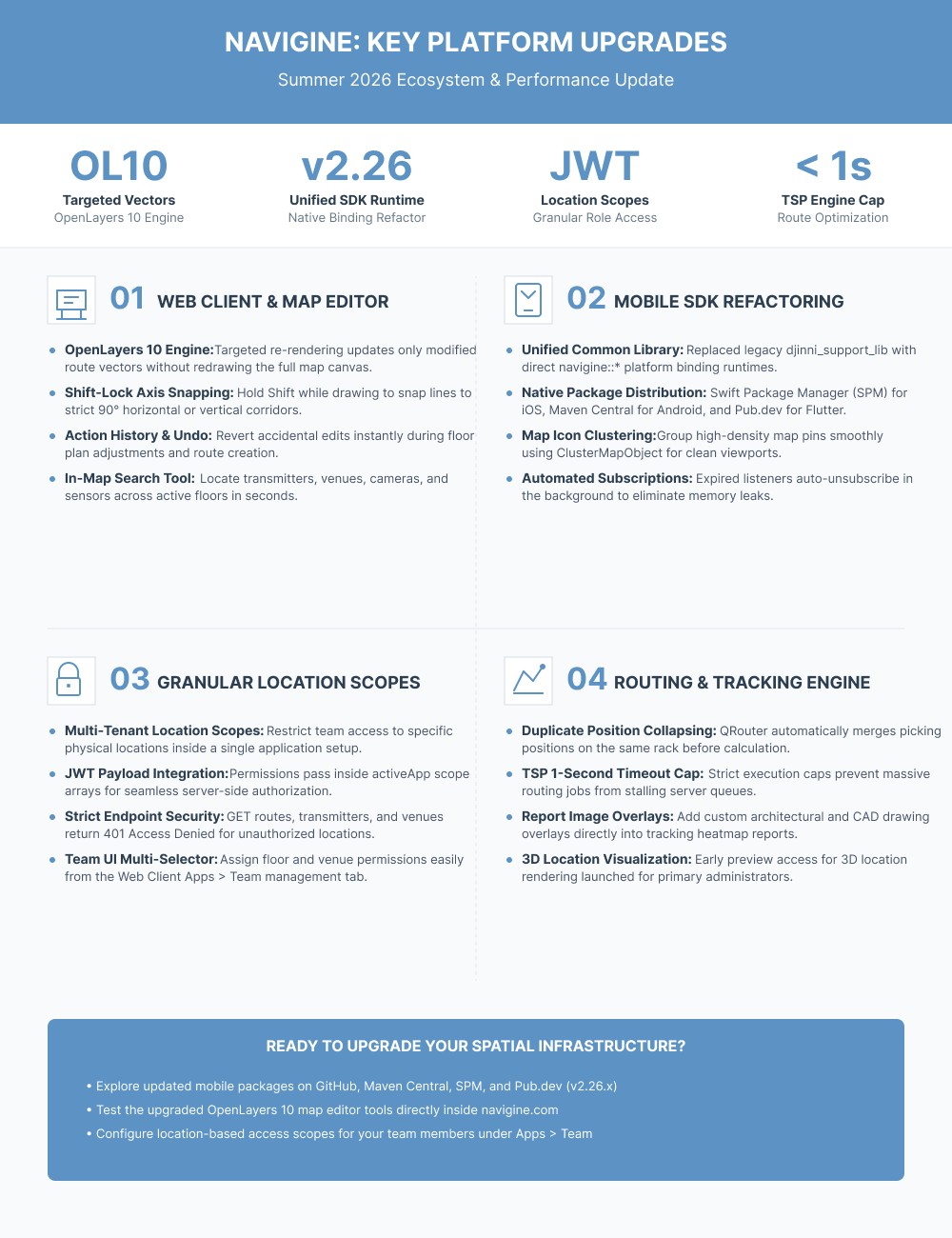
We are announcing a series of major product updates and structural changes across the Navigine platform ecosystem, finalized during the June and July 2026 development cycle.
These updates represent significant engineering investment into our core technology stack, focusing on architectural efficiency, runtime performance, and granular enterprise security.
All technical documentation at https://docs.navigine.com/ has been updated to reflect these changes. Integrators and software developers are advised to review the details below.
I. Web Mapping Engine: Migration to OpenLayers 10
The core Navigine Web Client has migrated its rendering backend from OpenLayers 5 to OpenLayers 10.
This major upgrade introduces significant performance gains for large-scale indoor venue deployments:
-
Selective Path Re-rendering: Modifying route geometries no longer requires a full-canvas redrawing cycle. The rendering engine selectively updates only changed path vectors, drastically reducing browser CPU overhead when editing dense path networks.
-
Rapid Directional Arrow Rendering: Single-direction route vectors render with noticeably increased speed.
-
Editor Usability & Precision Improvements:
-
Full Undo support is now active across all route editing operations.
-
Holding the
Shiftkey while drawing routes, barriers, or zones locks the line to strictly 90° horizontal or vertical axes. -
Fixed narrow viewport rendering and grid angle issues.
-
Map Element Search: An integrated search tool is now present within the map view toolbar, enabling instantaneous location of specific transmitters, venues, cameras, and sensors across the current floor.
-
UI Standardization: The main editing trigger button is now standardized as “Tools.” Header selectors for Location, Application, and License management tabs have been unified, and draw menus now feature standard transition animations.
II. Mobile SDK v2.26.x: Architecture Overhaul and Native Binding Runtime
The Mobile SDK family (iOS, Android, Flutter) has received structural refactoring to simplify native integration, improve runtime safety, and reduce dependency overhead.
A. Direct Binding Infrastructure
We have removed the legacy, vendored djinni_support_lib across all SDK binding layers. It is replaced by a unified common library that directly manages target platform binding infrastructure.
JNI (Android), Objective-C++ (iOS), and FFI (Flutter) generators have been rewritten to utilize native platform namespaces (navigine::android, navigine::ios, and navigine::bindings::flutter). Shared geometry and error classes (Point, Polygon, Error) are now separated into an independent IDL module (common.djinni).
B. Native Distribution Channels
Mobile packages are now distributed via platform-native channels:
-
iOS (SPM): Full support for Swift Package Manager. Point your Xcode project dependencies to the official GitHub repository (
Package.swift). -
Android (Maven Central): Android SDK artifacts are now published directly to Maven Central with Javadoc support on JitPack. Build scripts should reference this repository directly.
-
Flutter (Pub.dev): The latest packages, utilizing the new FFI wrappers, are live on pub.dev.
C. Lifecycle Management & Map Object Clustering
Generated bindings now handle implicit lifecycle management, automatically unsubscribing expired event listeners behind the scenes.
To manage heavy visual data density cleanly on mobile viewports, we introduced ClusterMapObject and ClusterMapObjectController for native icon clustering.
III. Backend Security: Location-Based Scopes (Granular Access Control)
Administrators managing multi-facility enterprise deployments can now enforce site-specific access controls.
We have implemented Location-Based Scopes directly into our authorization architecture:
-
API & JWT Scopes: Account administrators can assign granular visibility and management permissions down to specific locations within a shared application environment.
-
Payload Integration: The authorization engine Passes
scopes: { locations: number[]; }inside the JWT token’sactiveApppayload. -
Validated GET Endpoints: All core platform API endpoints (Locations, Sublocations, Elevations, Routes, Transmitters, Venues, Zones, and Navigation Logs) now enforce strict server-side location access validation. unauthorized queries return a
401 Access Deniederror code. -
Team Management UI: Added a dedicated Scopes column to the Team management view in the Web Client.
IV. Routing & Tracking Engine Acceleration
-
QRouter Optimization:
-
Strict 1-second execution timeout cap onTravelling Salesperson Problem (TSP) optimization queries to prevent queue stalls on massive requests.
-
Automatic collapsing of duplicate pickup positions (identicalrack coordinates with identical priorities) before solver execution.
-
Tracking Analytics Overlays: Tracking heatmaps and history reports now support explicit image overlays.
-
3D Venue preview: Primary account administrators can now access an initial beta preview of 3D location rendering within the Navigine Tracking application.
Implementation Guide and Community Feedback
We recommend all integrators review the updated documentation to evaluate the impact on current production builds.
The migration to SDK v2.26.x and OpenLayers 10 represents a decisive step toward faster, more secure, and maintenance-efficient spatial platforms.
We want to know: Are you prioritizing native package manager integration or the new icon clustering features first in your v2.26 updates? Share your integration challenges with our engineering support team directly.
Book a call with our experts to learn more at [u]https://navigine.com/book-a-demo/[/u]